


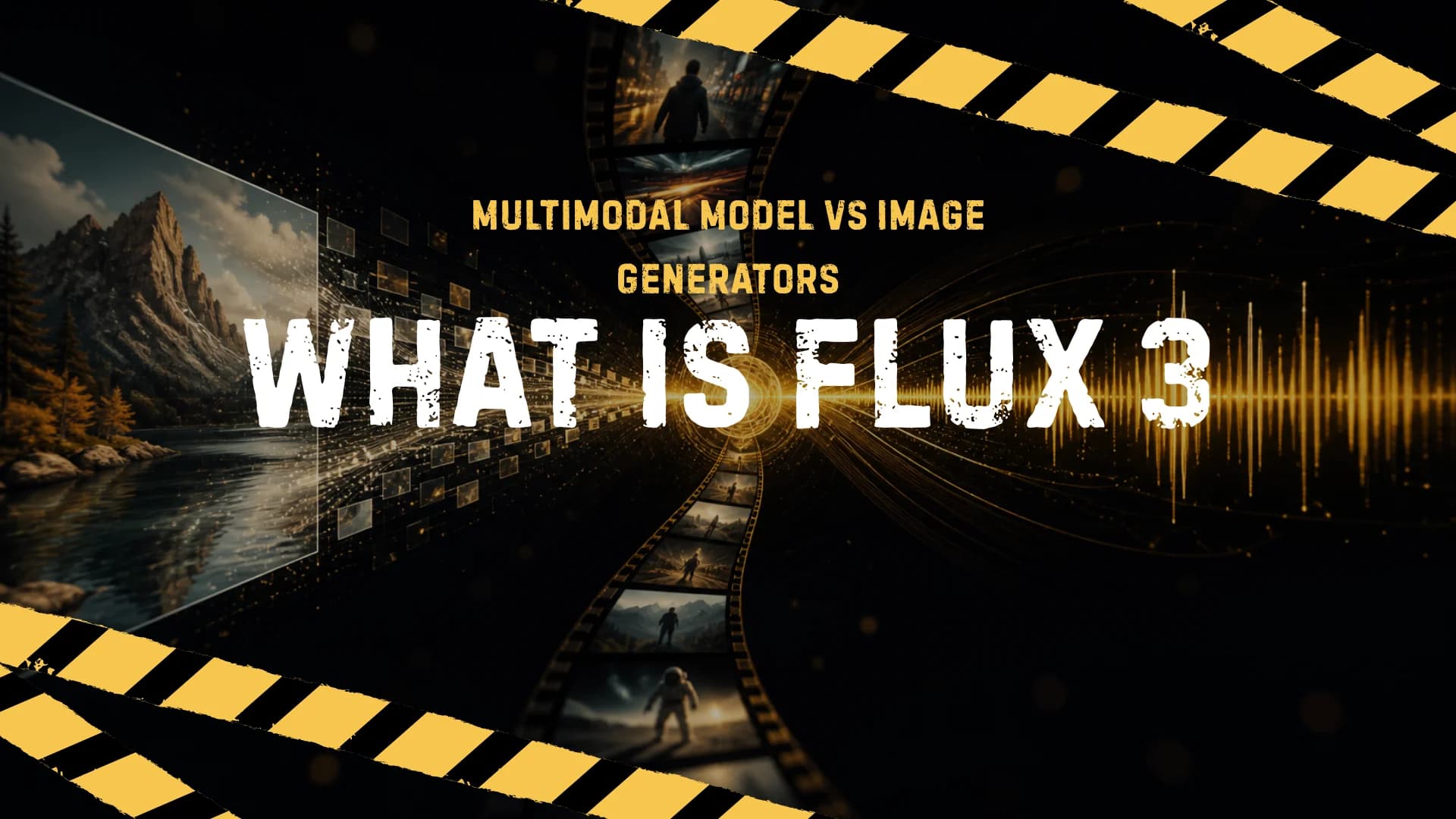
What Is FLUX 3? Multimodal Model vs Image Generators

FLUX 3 is Black Forest Labs' multimodal model for image, video with native audio, and more. See how it differs from today's focused image generators.
Short answer: FLUX 3 is Black Forest Labs' new multimodal model. It generates images, video with native audio, and audio from a single model. The team calls it a "Real World Model," a backbone for visual intelligence rather than a single-purpose image tool.
That framing matters. Most image models you can use today do one thing well: still images. FLUX 3 spans image, video, and sound in one model. This article covers what that means, how it differs from a focused image model, and where a focused image model is still the more practical choice.
TL;DR
- FLUX 3 is a multimodal model: image, video (with native audio), and audio in one
- The core difference from today's image generators is scope, not quality
- When the job is purely images, a focused model like Qwen Image 2.0 is the practical pick
What is FLUX 3?
FLUX 3 is the latest model from Black Forest Labs, the lab behind the FLUX series of image models. Earlier FLUX generations focused on still images. FLUX 3 handles several media at once:
- Image generation: text-to-image synthesis across styles, aspect ratios, and resolutions.
- Video generation: clips up to roughly 20 seconds, with native audio attached rather than added in a separate step.
- Audio generation: sound that pairs with the visual output.
- Action prediction: an early-stage direction, in partnership with mimic robotics, aimed at physical-world tasks.
The headline is the combination. One model producing image, video, and audio together is a different proposition than a model that only outputs still frames.
Black Forest Labs has published examples showing FLUX 3 producing a range of video styles and image outputs across resolutions. You can see the official demos on their announcement page.
FLUX 3 vs focused image models: the real difference
This is not a quality contest. Without running the same prompt through every model under identical conditions, any "which looks better" verdict is just opinion. What you can compare honestly is what each kind of model is built for.
| FLUX 3 | A focused image model (e.g. Qwen Image 2.0) | |
|---|---|---|
| Scope | Multimodal: image, video, audio in one | Image only |
| Video / audio | Yes (video with native audio, ~20s) | No |
| Image focus | Part of a broader model | The entire model |
| Best for | Projects that need image + video + sound together | Projects that need images, fast, at reasonable cost |
The tradeoff is straightforward. A multimodal model spreads its capacity across several media. A focused image model puts all of its capacity into still images. That matters when images are all you need.
For a product shot, a social graphic, or a marketing banner, you do not need video or audio in the loop. You need a sharp image, fast, at a reasonable cost. That is the gap a focused image model fills.
When FLUX 3 fits, and when an image model fits
FLUX 3 fits when the work is genuinely multimodal. A short video with sound. A sequence that moves from image to motion. A piece that needs visuals and audio produced together. Those are the jobs a unified model is designed for.
A focused image model fits when the output is an image. E-commerce product photography, ad creatives, social posts, design concepts, illustrations. The entire deliverable is a still image. What matters here is image quality, prompt adherence, resolution, and cost per generation, not whether the model can also make video.
Both categories coexist because they solve different problems. Choosing FLUX 3 for a job that only needs images is overkill. Choosing an image-only model for a job that needs video is a dead end.
If you need to generate images right now
When the task is images, not video or audio, Qwen Image 2.0 on Epochal is built for exactly that. Its capacity goes entirely into still images:
- Image quality: tuned for cleaner detail, more natural lighting and texture.
- Prompt understanding: follows detailed descriptions closely, so the first result is more likely to match the brief.
- Up to 2K resolution: large enough for posters, banners, and print-adjacent use.
- Bilingual prompts: write prompts in Chinese or English.
- Image editing: upload 1 to 3 reference images and direct changes in natural language.
For a focused image workflow like product shots, marketing visuals, or design iterations, it does the one job thoroughly, without the overhead of a broader multimodal model.
How to generate your first image
- Open Qwen Image 2.0 on Epochal and sign in with Google.
- Pick a credit pack — your first one is half price as a new account. No subscription required.
- Type a prompt describing your subject, scene, lighting, and style (Chinese or English).
- Pick an aspect ratio and generate. Your first image is ready in moments.
No credit card, no trial countdown. Write a prompt, iterate, and download.
FAQ
Is FLUX 3 an image model or a video model?
It is both. FLUX 3 is a multimodal model that generates images, video with native audio (up to about 20 seconds), and audio from a single model. It is not limited to one medium.
What is FLUX 3?
FLUX 3 is Black Forest Labs' multimodal model. The team positions it as a "Real World Model," a backbone for visual intelligence that handles image, video, and audio together rather than specializing in one.
Can FLUX 3 generate video with audio?
Yes. Video generation includes native audio attached to the clip, up to roughly 20 seconds, rather than requiring audio to be produced and synced separately.
How is FLUX 3 different from earlier FLUX models?
Earlier FLUX generations focused on still images. FLUX 3 expands the scope to image, video, and audio in a single model, a shift from a focused image model to a multimodal one.
What is a good image model to use right now?
For focused image generation, Qwen Image 2.0 is a practical choice. It puts its full capacity into still images, up to 2K, with strong prompt understanding and bilingual prompts.
Do I need video or audio for marketing images?
Usually not. Product photos, ad creatives, social graphics, and design concepts are still images. For those, a focused image model is the right tool. A multimodal model like FLUX 3 fits better when the deliverable itself includes video or sound.
Ready to generate an image?
If your work is images, Qwen Image 2.0 is live now. Sign in, type a prompt, and start with the half-price first credit pack.
More Posts
5 Best Image-to-Video AI Tools in 2026 (Compared)
The 5 best image-to-video AI tools in 2026, ranked by frame preservation, motion quality, and workflow fit — Kling, Veo, Seedance, Wan, and Grok compared.

HappyHorse 1.0 AI Video: Text-to-Video, Image-to-Video, and Cinematic Short-Form Workflows
HappyHorse 1.0 supports text-to-video and image-to-video for creative drafts, first-frame animation, ad testing, and short cinematic shots.
Best AI Video Generators in 2026
Compare Veo 3.1, Kling 3.0, Seedance 2.0, Wan 2.7, and Grok Imagine across quality, audio, prompt control, speed, cost, and workflow fit.